|
IntraCellular Diagnostics, Inc.
®

EXA Test®
4 EASY STEPS TO SUBLINGUAL EPITHELIAL CELL
SPECIMEN COLLECTION
Analytical
Scanning
Electron Microscopy (ASEM) is EXA:
Energy Dispersive
X-Ray Analysis
|
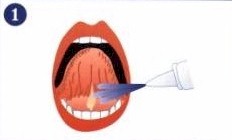
1. Rinse 3X with distilled water
|
1. Use utmost cleanliness.
-
The mouth must be very clean before
the specimen collection.
-
Patient should fast overnight. PT may
drink medications in the morning with plain water. When
sustenance is necessary, PT may have water soluble foods. Do not
chew anything sticky. Absolutely no dairy, no soy, no salt, no chewable
vitamins, no Tums, etc.
-
In the AM, Patient may brush
with a non calcium toothpaste.
-
Patient should rinse the
mouth and sublingual area before entering MD's office
-
Do
not contaminate spatula or carbon slide.
-
Rinse sublingual area with distilled water before
scraping.
|
|
|
|
2. Scrape the floor of the mouth. End the scraping of soft tissue
at the foot of the frenulum.
-
Start in the back of the mouth, in area
parallel to molars. End at the frenulum
shown in this picture.
-
Scrape firmly: Scraping should
produce a minor discomfort to the patient. If PT ate, clean/exfoliate
first with a spatula . Use a second clean spatula for collection.
-
Do not scrape the tongue, the
gums, the teeth, or the frenulum itself.
|
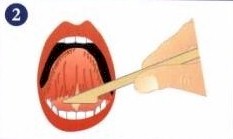
2. Scrape sublingual soft tissue
on the floor of the mouth.
End at Frenulum-shown here.
|
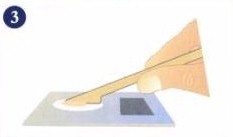
3. Transfer cells to circled area
shown here but
with
the flat side of the spatula.
|
3. Transfer cells:
-
Immediately while still
wet to circled area
shown here
-
Use the flat side of the spatula
as if spreading butter.
-
If the specimen dries you will
have to start all over again.
- Use a smearing circular motion.
- Be firm but do not press so hard that you scratch
or tear the
carbon slide.
|
|
4. Fix immediately after
collection while specimen is fresh and wet.
-
Drop two drops of our fixative
outside the circle.
-
Too much fixative will wash away the
cells.
-
Allow to dry before placing in small
envelope.
-
Properly fixed the specimen has an
indefinite life span, unless of course, it is exposed to water or
mutilation.
|
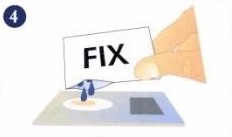
4. Apply 2 drops of fixative outside
of the circle, let it roll over the circle. Apply
immediately after transferring specimen and while specimen is still wet.
|
| ©Copyright
IntraCellular Diagnostics, Inc. 2014 |
|